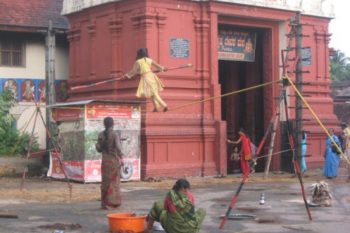
Picture Postcards: Graffiti in Mumbai, India
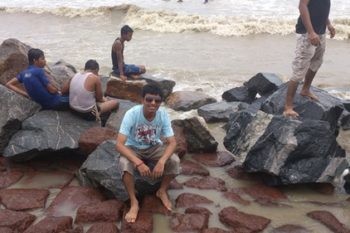
Today’s Picture Postcard has been sent in by our reader, Nisha, who is a traveller from India. Thanks, Nisha!
Read more:
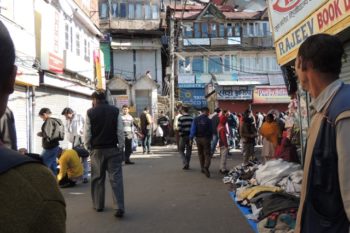
Street Scene Mumbai
The Great Big Coorgi Wedding
Eating Right- The Indian Way
Today’s Picture Postcard has been sent in by our reader, Nisha, who is a traveller from India. Thanks, Nisha!
Read more:
Street Scene Mumbai
The Great Big Coorgi Wedding
Eating Right- The Indian Way
Hand gestures play an essential role in nonverbal communication. However, the same gesture may have different meanings -or even none- in different cultures. This collaborative post is an effort to bridge that gap.
India – Namaste
Namaste literally means “I bow down to you”, or “Salutations to you”, but it is used in the sense a handshake is used in the western world. For us, no matter whether the person we greet is older or younger, important or not, a man or a woman, he/she has to be greeted with due respect, and the most common way is to join our hands as you can see my son doing in the image, and say, “Namaste”. When we are greeting an older person or someone important, we bow down a bit. This shows the additional respect due to that person. (more…)
Today’s photo is from India. It’s a flower seller making a garland, taken at the wholesale flower market in Mumbai. Thanks to Anu for the photo – she says this is “a common sight in India, especially outside temples and in the festival season”.
This month’s collaborative post was inspired by a conversation between some of our contributors about languages and how much they ‘borrow’ words from one another. Malay has words from English, Turkish has words from French, English has words from Hindi, Spanish has words from Arabic. Not to mention the massive way in which European languages have influenced each other.
So here’s a look at the history and foreign influences of some of the languages spoken by PocketCultures contributors around the world.
It’s a long article, so if you’re interested in a particular country use these links: India, UK, France, Canada, Turkey, Spain, Argentina, Costa Rica, Portugal, Malaysia.
Languages in India are as varied and complex as the country itself. The 2001 census estimated that there were 29 languages spoken by more than a million native speakers, 122 by more than 10,000!
We have 22 ‘official’ regional languages spoken across the country, but no ‘national language’. Hindi is often mistakenly referred to as the ‘national language’, but the constitution lists it as our ‘principal official language’. Where does Hindi come from? Well, it’s a language which evolved from a dialect spoken in northern India during the Mughal period, was influenced by Persian, and is closest to Urdu – the language today identified with Islam!
This photo of a woman selling spices on the streets of Mumbai, India was sent in by Anuradha, our contributor from India.
More about India:
New Year Celebrations in India
The Great Big Coorgi Wedding
I Wanted to Experience a Different Lifestyle
Calendars come in many forms, from huge ones hanging on walls to pocket-sized ones and today, digital ones on the computer or mobile. No matter what changes, one thing remains constant – the calendar itself. We have become so used to the Gregorian calendar that no one needs reminding about the day the New Year begins – the first day of January. It is difficult indeed to think of all the calendars which preceded the one we are so used to today.
However, one place where the ancient calendars still survive is in India, even though we follow the Gregorian calendar in our day to day life. When it comes to family celebrations, be it birthdays or weddings, a sacred thread ceremony, or even a death in the family, the first thing we hunt for is the Hindu calendar. Here again, there are so many versions, depending on the region we belong to. While some of us follow the solar calendar, others follow one which is called the ‘Luni-solar calendar’. Confused? Well, it is rather confusing even to those of us who have grown up with it. Just to give you an idea of the similarities and differences, let me tell you about two different new years that we celebrated this year. (more…)
Recent Comments