Post Tagged with "Buenos Aires"

Art and history at Recoleta Cemetery

A cemetery is probably not the first thing that comes to mind when one is planning a visit to a new city, especially if that person is interested in local art and history. Oddly enough, Recoleta Cemetery in Buenos Aires attracts many visitors a day for exactly those reasons.

Recoleta is well-known for its funerary art, especially the angels.

The cemetery was opened in November, 1822 – making it the oldest in the city – on land that belonged to the Augustine monks. The monks, known as recoletos, had been expelled after some changes were made to their Order. Although the monks left, their name stayed: the whole area of Recoleta is named after them. Only Christians could be interred there until 1863, when President Mitre decreed the cemetery open to people of all religions.

Recoleta Cemetery covers an area of 5.5 hectares (13.6 acres) right in  the middle of one of the most upscale neighbourhoods. Real estate, both inside and around the cemetery, is very pricey.

The cemetery is like an open-air museum or a Who is Who of Argentinean society. Its residents include members of the richest families, former presidents, military heroes, politicians, artists, sportsmen and even Antarctic explorer!

The mausoleums are works of art that reflect the fashion and beliefs of the period in which they were built, like Art Deco, Art Nouveau or Neo Gothic. Some of those mausoleums have been declared Patrimonio Histórico Nacional (Historic Heritage)

Mausoleum of Rufina Cambaceres, a fine example of Art Nouveau

Ironically, people who were sworn enemies in life ended up sharing their eternal resting place. For example, Evita Perón, whose mausoleum is one of the most sought-after, is not far from her husband’s nemesis, General Eduardo Lonardi (who led the revolution that ousted Perón in 1955)

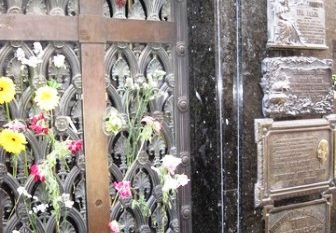
Understated mausoleum of Evita Peron. People still bring her flowers.

There are free guided tours every day in Spanish and English. The guides will surely mention some of the most famous urban legends that arose from the cemetery. Take Salvador Maria del Carril and his wife Tiburcia. Rumour has it she was a strong-willed woman who liked to spend her husband’s money. One day he decided not to honour her debts, they had a colossal row and never talked to each other again. Mrs del Carril decided that they would not talk to the rest of eternity either and designed their mausoleum in such a way that their statues would turn their back on one another. Only they know what really happened.

Tiburcia and Salvador Maria del Carril, an ill-matched couple


Read more

Ceibo, Argentina’s national flower
Camila O’Gorman, the romantic heroine of Argentina
Rebecca de Caro, a Denver native in love with Argentinean food and culture

December 7, 2011 1 comment

From our contributors: week of December 4

This is what some of our contributors were up to last week:

Sandra, our contributor from Portugal, writes about a show of light and fantastic creatures called Turn on the Lights 2011 at Dam Square (Amsterdam)

“A couple of weaks ago, I went to Amsterdam to meet my friend Raquel. She had invited me to watch a show at Dam Square. A show of light and fantastic creatures: Turn on the Lights 2011 by Bijenkorf”

DeeBee, our contributor from France, writes about the symbolism of Christmas Holly in France from the Celts to this day.

“The use of holly is full of symbolism that, once more, originated in paganism. Celts believed that its prickly leaves had magic power and protected from evil spirits…druids wore a sprig of holly in their hair during the Winter (and Summer) Solstice celebrations. This belief remained  and for centuries people hung a sprig of holly above their bed.” (more…)

December 6, 2011 0 comments

Picture Postcards: Taking a break in Argentina

taking a break in Buenos Aires

In August we have a new Picture Postcards photo theme – everyday people. We’d love to see photos of people where you live – please share them in our Flickr photo group (don’t forget to tag them ‘everyday people’).

(more…)

August 1, 2011 0 comments

Urban Pilgrims in Buenos Aires

My feet were killing me. My legs were practically devoid of feeling. Even my hip joints hurt. I was beyond tired but the thought of seeing the Basilica in all its glory kept me going. That, and a touch of pride too.

My group and I had joined tens of thousands of people from all walks of life in the biggest and most popular display of Christian faith in Argentina, the Peregrinación Juvenil -a 67 kilometre long trek from Buenos Aires to the sleepy town of Luján, home of the eponymous Basilica and the statue of Our Lady of Luján, the country’s patroness.

(more…)

August 23, 2010 1 comment

Tango: passion and nostalgia

Mi Buenos Aires querido,
Cuando yo te vuelva a ver
No habrá más penas ni olvidos

(My beloved Buenos Aires / when I next return to see you / I’ll grieve no more)*

Credit: Todo Tango

These are the opening lines of one of the most famous tango songs of all times, Mi Buenos Aires Querido, released in 1934. It was also the soundtrack of an eponymous 1936 film. The song (and the film) is about an emigrant’s yearning for his beloved city, his old haunts and the people he left behind.

Melancholy, hard luck, crushed dreams; longing for hearth and home, unrequited love, heartbreak, social issues, the passage of time are the recurrent themes of tango songs.

(more…)

May 26, 2010 5 comments

Cafe culture in Buenos Aires

Porteños, as locals are called, like to get together with friends to have leisurely discussions ranging from the whys and wherefores of life to their beloved football team, the course of the economy (always in some sort of crisis or another), or their amorous escapades in excruciating detail (they are, after all, of Latin descent, and, let’s face it, men like bragging).

Cafes are not only a rendezvous for friends: job interviews and work-related meetings also take place in them. Even love affairs begin and end over steaming cappuccinos.

Cafes are quite busy early in the morning, when office workers stop by for a breakfast of the national combo: “cafe con leche y medialunas” (white coffee with croissants) or a “tostado mixto” (a ham and cheese toasty). The morning paper is usually provided as well. It can safely be said that a cafe is an extension of home and office.

Breakfast in Buenos Aires

(more…)

March 8, 2010 16 comments