Post Tagged with "Internet"

From rural Mali to the world

Yaya Coulabaly is part of a group called Fasokan Segou which uses the Internet to connect with the world outside Mali. Here he tells us more about the project, and life in rural Mali.

Hello Yaya, thank you for taking the time of answering our questions. Can you briefly introduce yourself to our readers?

Hello and first of all a big thank you to Eddie Avila from Rising Voices and Lucy Chatburn from PocketCultures for giving me the opportunity to talk of rural Mali and our blog.


Yaya Coulibaly

My name is Yaya Coulibaly, I’m 27 and am agronomist (agricultural technician and engineer). I play football and love soft music as it allows me to work on my data without losing focus.

(more…)

September 23, 2011 1 comment

Living inside the Great Firewall

As an online geek, one of the most inconvenient aspects of living in China is being trapped inside the infamous Great Firewall. Stuck inside the wall, technically I am unable to access YouTube, Facebook, all blogging platforms (WordPress, Blogspot, Tumblr, etc. including my own blog), Twitter, FourSquare, Google Documents & Google Calendar at times, and the list continues. You can imagine sheer frustration of those unfortunate ones, confined to an unnatural limited cyber space. World Wide Web in China doesn’t read exactly World Wide Web, but more like Webs Within the Wall.

From my experience, Internet users in China split into three camps – the Rebels, the Don’t Cares, and the Completely Unawares.

(more…)

July 9, 2010 3 comments

Finding love on the Internet

This morning I stumbled across BBC World Service’s Outlook programme, which was talking about interracial dating. The programme was part of a series on Internet love stories.

Many of those featured found love with someone from another country. One of them is James, who has been married for eight years:

(more…)

March 12, 2010 0 comments

Is there an easy way to blog in a different language?

Last week I wrote a post for Darren Rowse’s Problogger site on How to Blog for a Global Audience. There were a lot of good comments which you can read on the post, if you’re interested.

The part which provoked the most discussion was on how to make your blog available in different languages. Many of you are interested in being able to blog in different languages and it makes sense. If you blog in English, around 30% of the online population can understand what you write. If you blog in English, Spanish and Chinese, you reach over half of the online world.

So how can you publish your blog in different languages? Especially if you don’t happen to know Spanish or Chinese? (since you’re reading this I’m assuming you know English). In the post I suggest that if you have not got another option then using a translation plugin or widget on your site could be something to consider.

A lot of commentors quite rightly pointed out that machine translation is no substitute for either blogging directly into another language, or using a professional translator. A machine translation will help you to understand what an article is about, but you will need perseverance, imagination and a lot of patience to decipher some of the finer points. It’s useful if there is no other option but can only really be counted as a last resort.

As far as using a professional translator goes, for a commercial website this is a must. But if we are talking about making your blog available in many different languages is it really practical? Professional translation costs money, and let’s face it, most blogs don’t make enough to pay for those services. Some blogs rely on volunteer translators – Global Voices Online has a large network of volunteers who translate posts into different languages. But I guess most blogs just don’t have access to this kind of service.

Some bloggers do blog directly in different languages. Collazo Projects publishes most posts in both English and Spanish (it helps that they are a US/Cuban husband and wife team) and Benny Lewis (who calls himself the Irish Polyglot) makes 7 versions of each post in his videoblog in 7 different languages! Of course for this you have to know a different language well enough to be able to blog in it, and you can only blog in languages you know. I’m guessing there are very few people in the world who happen to be able to write in all 3 of the top Internet languages.

So what is the solution? There are many different languages around on the Internet, and only a few polyglot people can pass between these different ‘worlds’. How can we help these different worlds to talk to each other?

On PocketCultures we wrote recently about an interesting project in China where a group of volunteers translate The Economist magazine into Chinese every week.

Are these kind of projects the way forward? Is there a better solution? What do you think?

Read more:
The world’s most difficult languages
How difficult is Chinese?
World language families

March 16, 2009 4 comments

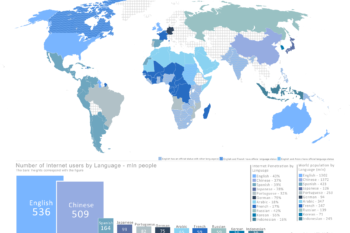
Top 10 languages on the internet

Or why you should consider learning a new language / translating your blog.

We recently wrote about the most widely spoken languages in the world. Learning a new language takes a lot of effort so it helps to know which one will get you the most conversation opportunities.

Well, the internet is one of the hottest places to interact with people from different countries so it makes sense to have a look at the top languages used on the Internet as well.

This list is by Internet World Stats, which counts the number of internet users speaking each language. The numbers were last updated in June 2008.

The Top 10 Internet Languages

1. English (431m)
2. Chinese (276m)
3. Spanish (125m)
4. Japanese (94m)
5. French (68m)
6. German (61m)
7. Arabic (60m)
8. Portuguese (58m)
9. Korean (35m)
10. Italian (35m)

So Chinese and English get the top spots, no surprises there.

But number 3 is Spanish, replacing Hindi in the top 3 spoken languages (more on this in a future post).

Chinese is counted as one language here because the different dialects use a common writing system, although their spoken versions (eg Mandarin, Cantonese etc) are quite different.

Languages to watch

In 2020 this ranking could look very different. Chinese now outnumber Americans online, according to a report released this month. How long before Chinese replaces English in the number one spot?

Spanish is also increasing quickly, as is Arabic. With only a small percentage of its native speaker population online, Arabic is likely to rocket up this list in the next few years.

The future of English

As the USA has led the sprint online, English has been the dominant language on the Internet until now. But as online populations grow in the rest of the world, so does the challenge of other languages on the web.

The big question is, will English continue to be used for communication between different cultures, or will the internet split up into self-segregating communities based on preferred language?

In the long term the role of English as a ‘bridge’ language across cultures may give it the upper hand. But this might not help native English speakers – it seems they cannot understand International English as it is spoken by non-native speakers.

Update: Global Culture blog analyses some cultural implications of the increase of Chinese on the web in the post a billion web users.

Read More:
Top 20 Languages of the World
How difficult is Chinese?
Is there an easy way to blog in a different language?

January 26, 2009 5 comments